
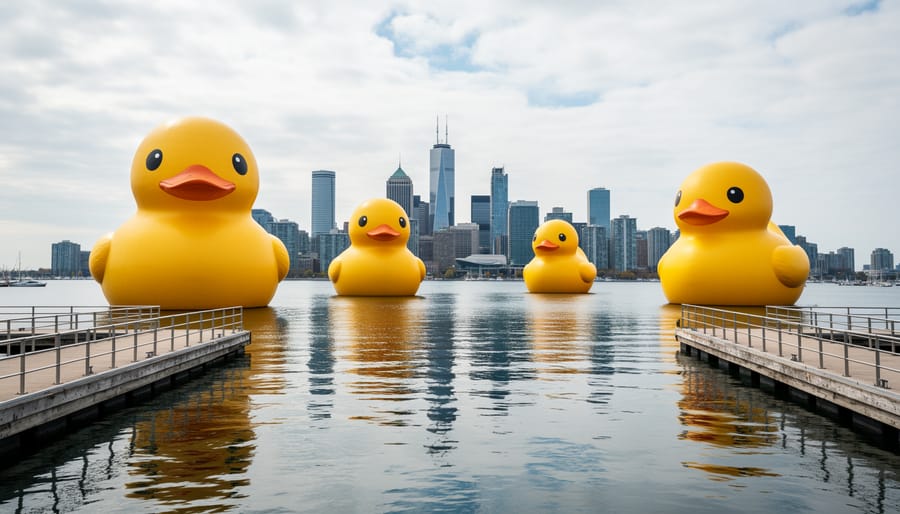
The Mondo Mash Giant Rubber Duck Regatta brings five supersized yellow ducks to Toronto’s waterfront, turning the city’s harbour into an oversized bathtub and delivering one of the most playful public art experiences you’ll encounter. Each duck stands roughly six stories tall, weighs over 11,000 kilograms, and requires a small army of handlers to inflate, anchor, and maintain throughout the exhibition period.
What started as a Dutch artist’s whimsical concept has evolved into a touring phenomenon that draws hundreds of thousands of visitors wherever these inflatable icons land. Toronto’s version takes the spectacle further by deploying not one but five of these massive waterfowl simultaneously, creating a rare photo opportunity that’s part surrealist art installation, part family-friendly festival.
You’ll find the ducks stationed at strategic points along the waterfront, each easily visible from shore and accessible by foot, bike, or transit. The installation runs for several days, typically during summer or early fall, with free public viewing from dawn until the evening light show begins. Virtual visitors can tune into live streams, 24-hour webcams positioned at optimal angles, and a dedicated social media hub where the organizing team shares behind-the-scenes content and real-time updates on weather conditions, crowd levels, and the best viewing times.
The appeal cuts across every demographic. Toddlers shriek with delight, teenagers hunt for the perfect Instagram angle, and adults find themselves grinning at the absurdity of it all. This isn’t highbrow conceptual art that requires a degree to appreciate. It’s immediate, joyful, and genuinely strange to witness in person.
The Story Behind Toronto’s Five Giant Ducks
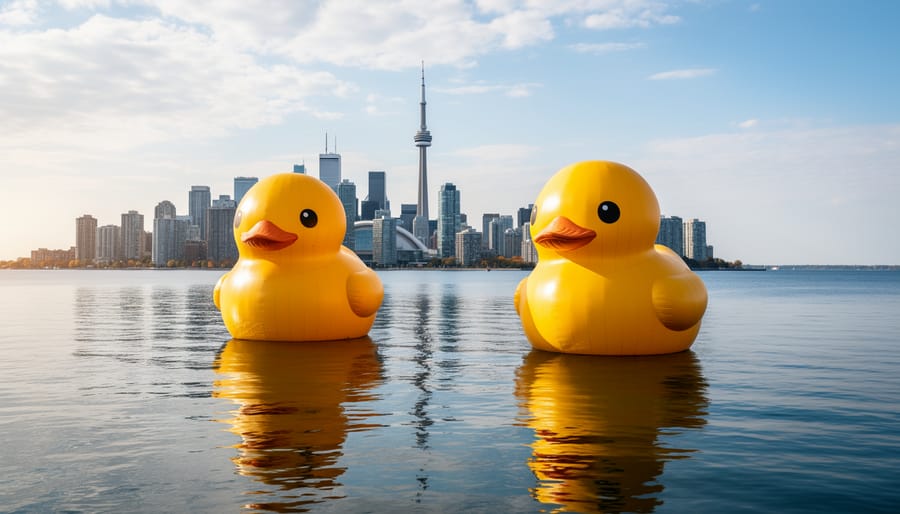
The five giant ducks floating along Toronto’s waterfront weren’t just random installations. They emerged from a deliberate evolution of public art that started years earlier when a single massive rubber duck captured the city’s imagination during Canada’s 150th birthday celebrations in 2017.
That first duck, created by Dutch artist Florentijn Hofman, drew massive crowds to the Harbourfront and sparked something unexpected: pure, unfiltered joy in a city that sometimes takes itself too seriously. People lined up for hours just to snap a photo with the six-story-tall yellow icon. The installation proved that Torontonians craved playful, accessible public art that didn’t require an art degree to appreciate.
When organizers at Waterfront BIA and the Toronto Arts Council started planning the Giant Rubber Duck Virtual Event, they faced a challenge. How do you recapture that magic while making it accessible to people beyond the waterfront? The answer: go bigger. Five ducks instead of one, each stationed at different points along the harbour, creating a waterfront scavenger hunt that would draw people to overlooked corners of the city’s shoreline.
The concept drew inspiration from Hofman’s global duck installations, but the multi-duck approach was uniquely Toronto. Local event producers collaborated with community groups across the waterfront neighbourhoods, ensuring each duck’s placement highlighted a different aspect of the city’s relationship with Lake Ontario.
The virtual component came from necessity turned opportunity. Not everyone could travel downtown, and the pandemic had proven that digital experiences could bring communities together in surprising ways. By pairing the physical installations with online engagement, the five ducks became more than statues to visit. They became characters in a city-wide story that anyone could follow, share, and celebrate from wherever they called home.
Meet the Magnificent Five: Each Duck’s Unique Character
The five ducks that made up Toronto’s waterfront spectacle weren’t just identical yellow clones floating in different spots. Each one had its own personality, quirks, and prime viewing experience, turning the hunt to see all five into a genuine adventure around the harbour.
Duck One: “The Harbourfront Hero” claimed the most iconic spot at the Harbourfront Centre. Standing 30 feet tall and weighing just over 11,000 pounds, this was the duck that greeted most visitors first. Its bright yellow glow against the CN Tower backdrop made it the most photographed of the bunch. What set this one apart was its slight tilt to the left, giving it a curious, inquisitive look as if it was perpetually checking out passersby.
Duck Two: “The East Ender” floated near the Distillery District waterfront, creating an amusing contrast between historic brick architecture and inflatable whimsy. At 28 feet tall, it was slightly smaller but positioned closer to shore, making it the most accessible for up-close photos. This duck featured a distinctive orange beak that seemed brighter than the others, probably due to the afternoon sun hitting it just right.
Duck Three: “The Island Guardian” bobbed near the ferry docks at Jack Layton Ferry Terminal. This 32-foot giant was the tallest of the five and had the choppiest waters to contend with, which meant it bounced and swayed more dramatically than its siblings. Watching it from a departing ferry offered the best perspective on its massive scale.
| Duck Name | Location | Height | Special Feature | Best Viewing Time |
|---|---|---|---|---|
| The Harbourfront Hero | Harbourfront Centre | 30 feet | Iconic CN Tower backdrop, slight leftward tilt | Sunset (golden hour photography) |
| The East Ender | Distillery District waterfront | 28 feet | Closest shore access, brightest orange beak | Mid-afternoon (best lighting on beak) |
| The Island Guardian | Jack Layton Ferry Terminal | 32 feet | Tallest duck, dramatic wave motion | Morning (ferry departure views) |
| The West End Wanderer | Ontario Place waters | 29 feet | Reflective surface effects, retro backdrop | Late afternoon (reflection shots) |
| The Beaches Beauty | Woodbine Beach | 27 feet | Sandy shore access, boardwalk views | Early morning (peaceful, fewer crowds) |
Duck Four: “The West End Wanderer” anchored in the waters near Ontario Place, where the retro Cinesphere dome created a distinctly Toronto backdrop. At 29 feet, this duck seemed to change colour throughout the day as the sun reflected off the surrounding glass and metal structures, sometimes appearing almost golden.
Duck Five: “The Beaches Beauty” was the only duck positioned in Lake Ontario proper, floating off Woodbine Beach in the east end. The smallest at 27 feet, it compensated with the best beach access, allowing visitors to see it from the sandy shore rather than concrete walkways. This one had the calmest waters and stayed remarkably still, making it the easiest to photograph without motion blur.
How the Virtual Event Connected Duck Lovers Everywhere

The Giant Rubber Duck Virtual Event transformed a local waterfront spectacle into a global phenomenon, proving that joy can travel farther than any physical installation ever could.
Organizers launched a multi-platform digital experience that let duck enthusiasts from Vancouver to Dubai join the fun. The centerpiece was a series of live streams positioned at each duck location, broadcasting 24/7 throughout the event. These weren’t static camera feeds, either. Professional videographers captured the ducks at different times of day, from misty sunrise moments when the harbour waters were calm to golden hour when families gathered for photos. Viewers could toggle between locations, choosing which duck to visit virtually at any moment.
The social media campaign gave participants a voice in the experience. The hashtag #Toronto5Ducks trended nationally as people shared their favorite duck (Team Yellow dominated, though Team Blue had fierce defenders). Virtual attendees could submit photos, art, and stories that appeared on a real-time digital wall displayed at the waterfront and on the event website. One Vancouver artist’s duck-inspired digital painting got so much attention it was printed on official event merchandise.
Interactive elements kept the online community engaged beyond passive viewing. Daily virtual scavenger hunts challenged participants to spot specific details in the live streams, from a particular boat passing by to a dog wearing a duck costume. Winners received digital badges and entries into prize draws for Toronto travel packages.
Perhaps most surprisingly, the virtual event attracted more participants than the physical one. Over 200,000 people from 47 countries logged in during the two-week installation. Parents in rural communities hosted duck-viewing parties. Retirement homes in different provinces connected their residents to the streams. The ducks became a shared touchpoint, a moment of collective delight that transcended geography and proved that sometimes the silliest things bring us together in the most meaningful ways.
Best Spots to See All Five Ducks (And Insider Tips)
Want to see all five ducks without spending your entire day wandering the waterfront? Start at HTO Park West around 9 a.m. on weekdays when cruise ship crowds haven’t arrived yet. From there, it’s a scenic twenty-minute walk east along the Martin Goodman Trail to HTO Park East, where Duck Two holds court near the Slip.
The middle stretch between Harbourfront Centre and Sugar Beach hosts Ducks Three and Four, spaced about ten minutes apart on foot. Duck Five anchors the eastern end at Corktown Common, roughly a forty-minute walk from Sugar Beach or a quick streetcar ride on the 504 King line if your feet need a break. The entire route spans about 4.5 kilometres and takes two to three hours at a leisurely pace, factoring in photo stops and the occasional detour for coffee.
For photographers, the best angles come from slightly elevated positions. The boardwalk stairs at HTO Park and the bridge approach at Corktown Common offer clean sightlines without fencing in your frame. Avoid shooting directly into the sun during midday unless you’re aiming for dramatic silhouettes.
Accessibility matters here. The entire waterfront path features smooth, wide pavement suitable for wheelchairs, strollers, and mobility devices. Accessible washrooms sit at Harbourfront Centre, near Sugar Beach, and at Corktown Common. Each duck location includes barrier-free viewing areas, though weekend crowds can make close approach challenging.
Pack water and snacks, but you’ll find plenty of options along the way. St. Lawrence Market sits two blocks north of the eastern ducks, while Harbourfront’s food vendors cluster around the central viewing areas. Several patios offer duck-side dining if you want to linger.
Looking to maximize your Toronto weekend plans? The ducks pair beautifully with other waterfront attractions. Many visitors combine duck viewing with ferry trips to the Islands or evening concerts at Harbourfront. Check local listings for what to do this weekend and build a full waterfront day around your duck pilgrimage.
Why Giant Rubber Ducks Matter to Toronto
Toronto doesn’t take itself too seriously, and that’s exactly why five enormous rubber ducks floating along the harbour feel so perfectly on-brand. These installations do more than attract Instagram photographers, they reshape how residents and visitors connect with public spaces along the waterfront.
The economic ripple effects tell part of the story. When the ducks arrived, waterfront events drew record crowds, with local businesses reporting significant upticks in foot traffic. Restaurants, ferry services, and retailers near the harbour all benefited from the influx. But reducing the ducks to tourism numbers misses their deeper cultural value.
These installations give Toronto permission to embrace whimsy in a city often dominated by glass towers and financial headlines. They create what urbanists call “shared moments of delight”, experiences that cut across age, income, and background. A Bay Street executive stops to smile at the same sight that captivates a five-year-old. Newcomers to Canada stand alongside multi-generation Torontonians, all equally charmed by oversized bath toys bobbing in the harbour.
The ducks also reinforce Toronto’s growing reputation as a city willing to experiment with public art that’s accessible rather than austere. Unlike installations that require explanation or art history degrees, giant rubber ducks communicate instantly. They signal that downtown Toronto can be playful, unexpected, and fundamentally human-scaled despite its metropolitan ambitions.
Most importantly, they spark conversation. Strangers chat while waiting for the perfect photo angle. Families plan entire afternoons around seeing all five. Social media fills with duck content that portrays Toronto as joyful rather than just efficient. That shift in narrative matters more than any official tourism campaign ever could.
Whether you caught all five ducks in person or followed along through the virtual event, these oversized icons reminded us why Toronto works. In a city where someone’s daily commute might take them through a dozen different cultural neighbourhoods, giant rubber ducks became the universal language nobody needed translated.
The real magic wasn’t just the ducks themselves. It was watching a Bay Street executive snap selfies next to families from Scarborough, tourists from Berlin, and kids who’d dragged their parents down to the waterfront specifically to see “the big yellow duckies.” For a few glorious weeks, our waterfront became less about where you were from and more about sharing something genuinely delightful.
These installations won’t stick around forever, but their impact does. They’ve shown us that public art doesn’t need to be serious to be significant. Sometimes the most profound community moments come wrapped in bright yellow vinyl, floating cheerfully in the harbour.
So if you haven’t made it down yet, go. Bring your phone, bring your kids, bring your skepticism. The ducks don’t mind. They’ll still be there, bobbing along, waiting to make you smile despite yourself.